
Conflict is often treated as a communication problem.
A misunderstanding.
A difference of opinion.
A difference in opinion.
So the instinct is to explain better.
Offer more clarification.
Defend your point more precisely.
Yet, even after this effort, some conversations stay unresolved.
You leave thinking:
“I said exactly what I meant.”
But something still feels off.
The source of most conflict lies deeper than it appears.
It starts underneath it, in the part of the conversation that never gets said out loud.
Why Conversations Break Down (Even When You’re “Communicating Clearly”)
What people argue about is rarely the real issue.
On the surface, it looks like:
- tone
- timing
- wording
But underneath that, something more complex is happening.
There are:
- expectations that were never clearly expressed
- assumptions that were never checked
- emotional reactions that were never acknowledged
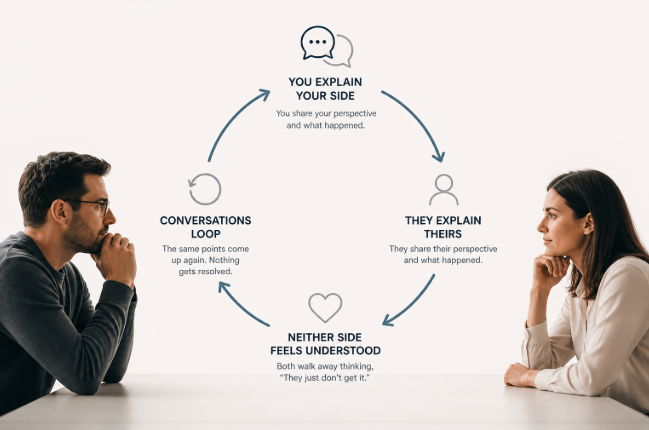
And when those layers stay unspoken, conversations begin to loop.
You explain your side.
They explain theirs.
Both of you are technically “clear.”
But neither side feels understood.
So, despite clarity, resolution remains elusive.
The Framework Most People Are Missing
Most people try to resolve conflicts at the level it appears.
Clarity comes from addressing what’s beneath the surface.
It comes from moving through the layers underneath it.
There are three.
And each one changes the conversation in a different way.
Layer 1: What Happened (The Observable Facts)
This is where almost every conversation begins, and often where it stays.
It sounds like:
- “The deadline wasn’t met.”
- “That comment felt unnecessary.”
It’s factual.
It’s observable.
It’s easy to point to.
It feels productive because it’s concrete.
But on its own, it’s incomplete.
Because facts don’t create conflict.
Interpretation does.

Layer 2: What It Meant (The Story You Told Yourself)
This is where things start to shift.
Because what happened is only part of the experience.
What it meant to you is what drives your reaction.
It often sounds like:
- “You didn’t prioritize this.”
- “You don’t respect my time.”
This is the layer most people feel… but don’t say directly.
Instead, it shows up indirectly:
- in tone
- in defensiveness
- in subtle tension
And because it’s not named, the other person responds to your reaction
without ever understanding what caused it.
Layer 3: What It Created (The Emotional Impact)
This is the layer most people avoid when working through conflict.
Not because it’s unimportant,
But it requires a different kind of vulnerability.
It sounds like:
- “It made me feel overlooked.”
- “It created pressure I wasn’t expecting.”
This is the point where conversations gain real clarity by naming the true emotional impact, making it possible for both sides to understand how actions affected one another.
Because instead of assigning blame,
You’re revealing experience.
And experience, especially when you describe the feelings it created, like feeling let down or anxious, is much harder to argue with than interpretation.
Without this, people defend. With it, they understand.
With it, people start to understand each other.
Why High Performers Often Miss This
High achievers are trained to operate efficiently.
To stay composed.
To move forward quickly.
To avoid unnecessary friction.
Which works… until it doesn’t.
Because in conflict, that same conditioning can lead to:
- staying at the surface (over-relying on logic)
- skipping the emotional layer (over-regulating response)
So conversations become:
productive… but not resolving
clear… but not connecting
And what’s left is not open conflict,
but something quieter.
Tension that lingers.
Misalignment persists.
Distance grows over time.
The Shift That Changes Everything
Clarity is not about saying more.
It’s about accessing the right level of the conversation.
Apply the right conversational level strategically.
When leaders learn to:
- Separate facts from interpretation.
- Notice the story they’re telling themselves.
- Articulate impact without blame.
- Stay present instead of reactive.
Conflict’s role shifts when clarity improves.
It stops being something to avoid…
and becomes something that actually strengthens trust.
Because when people feel understood,
They become far more open to understanding you.
A Different Way to Think About Conflict
Most people approach conflict like something to fix quickly.
But clarity doesn’t come from speed.
It comes from depth.
From being willing to pause long enough to ask:
- “What actually happened here?”
- “What did I make that mean?”
- “What was the impact on me?”
Those questions shift the conversation.
from reaction → to awareness → to resolution.
If This Resonates With You
If you’ve had conversations that felt like they went in circles…
or situations that looked resolved on the surface but didn’t feel complete…
There’s often a missing layer of clarity.
And it’s not always obvious until you slow down enough to see it.
This kind of work goes beyond communication techniques.
It’s about understanding how you interpret, react, and show up in real time, especially under pressure.
If you’re interested in developing this level of clarity more intentionally, I provide one-on-one coaching and structured group spaces designed for high-performing professionals who want to navigate conflict with more precision, confidence, and emotional depth.
You can explore that when you’re ready.